About Me
I am currently a third year undergraduate student at the University of Texas at Austin studying physics and astronomy. Outside of academics, I enjoy painting, ceramics, and spending time with my dog.
Education:
BS Astronomy Honors and BS Physics 2028
Research Interests:
Galaxy Evolution, Chemical Evolutions, The High Redshift Universe
Publications: My ADS link!
Research
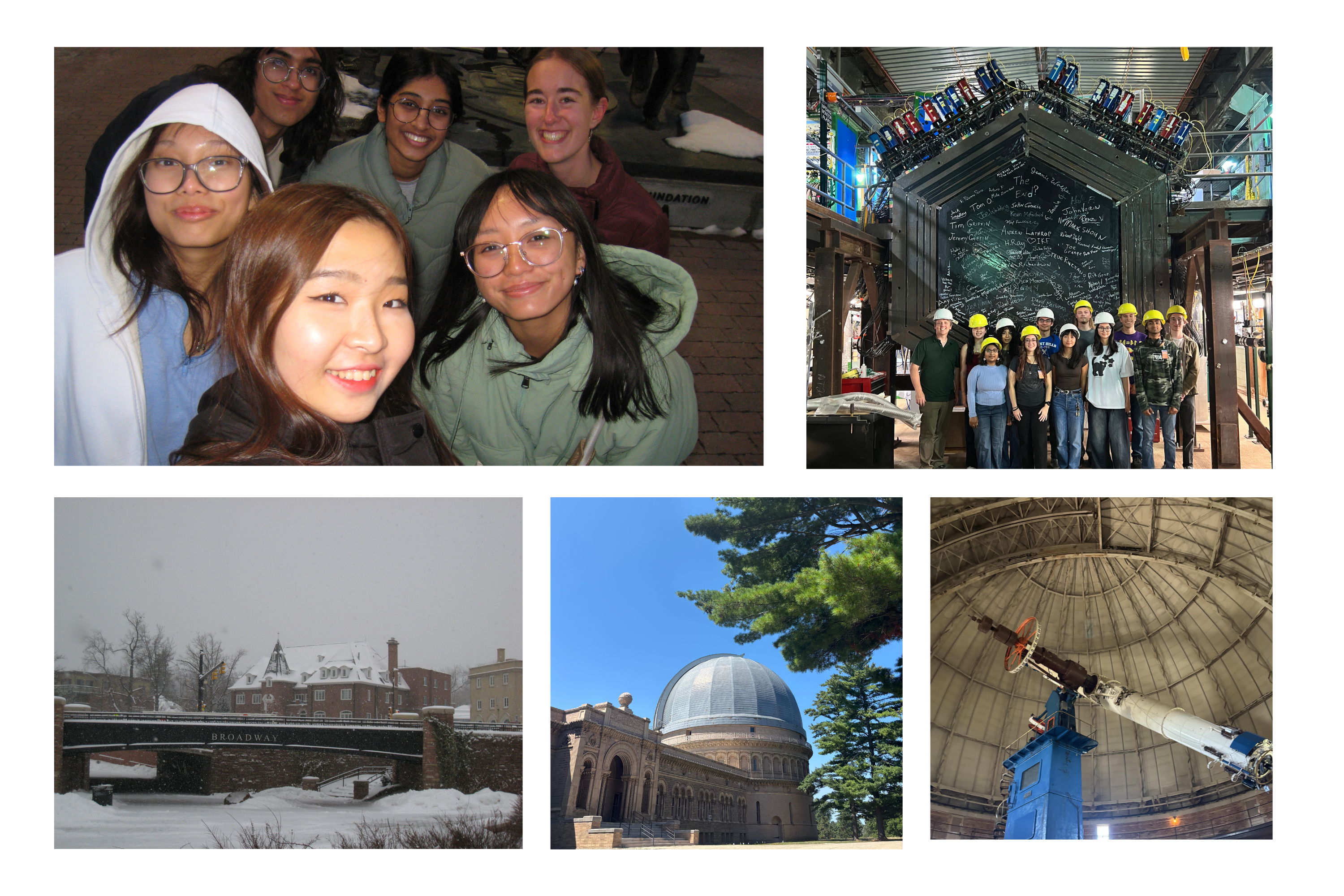
CIERA REU 2026: Characterizing Host Galaxies of SLSN-1
This past summer, I was fortunate to be able to attend the REU program at Northwestern's CIERA where I worked with Professor Allison Strom to understand properties of superluminous supernovae host galaxies. Superluminous supernovae (SLSNe) are the most recently discovered class of supernovae. Using the properties of the galaxies where these events take place, we can help constrain models for possible progenitors. Using Cue, a neural net emulator, we developed a consistent method of inferring the gas-phase metallicity and ionizing conditions of these hosts.
Improving SLSN-1 Host Sample Selection
SLSNe spectra are available from numerous surveys, with the number of detections growing every year. Currently, there are ~300 confirmed detections of SLSN-1. However, spectra of their respective host galaxies are much more limited. Our sample includes 14 SLSN-1 hosts with events detected from the Palomar Transient Factory (PTF) and Zwicky Transient Factory (ZTF). The spectra of the host galaxies was obtained from public archives and were measured from various instruments such as Low Resolution Imaging Spectrometer (LRIS).
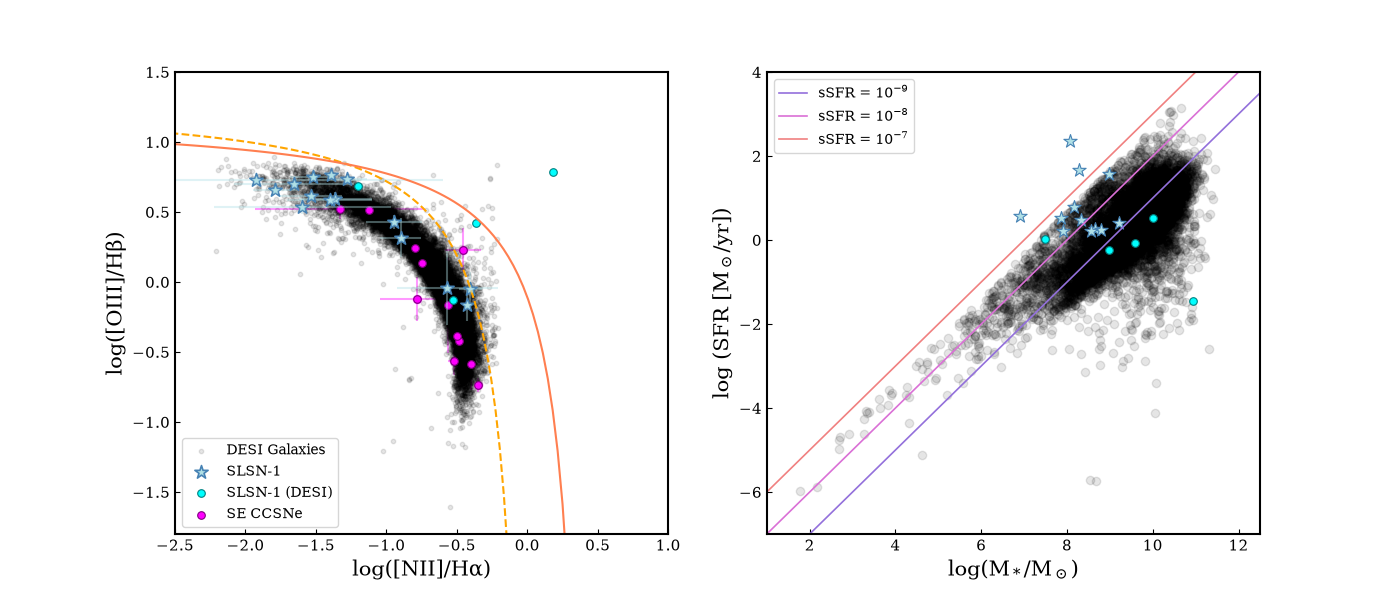
Because SLSNe hosts are so rare, identifying possible relationships and trends in their characteristics is difficult. For this reason, it is important to place them in a larger context of other galaxies in order to see if they occupy specific regions of parameter space. For this reason, we employ the first data release from the Dark Energy Spectroscopic Instrument (DESI). The figure above demonstrates that SLSNe are primarily star-forming galaxies and that DESI adequately covers parameter space. We then used Cue to infer the ionizing characteristics and gas denisties of these hosts using emission line luminosities.
Results
While the results of this preliminary study do not necessarily reveal any new trends, they do reflect the strength of Cue in reproducing the ionizing spectrum and various nebular properties. Our results agree with previously established trends, primarily that SLSN hosts are relatively metal poor, falling into values around 50% of solar metallicity (Z < 8.4).
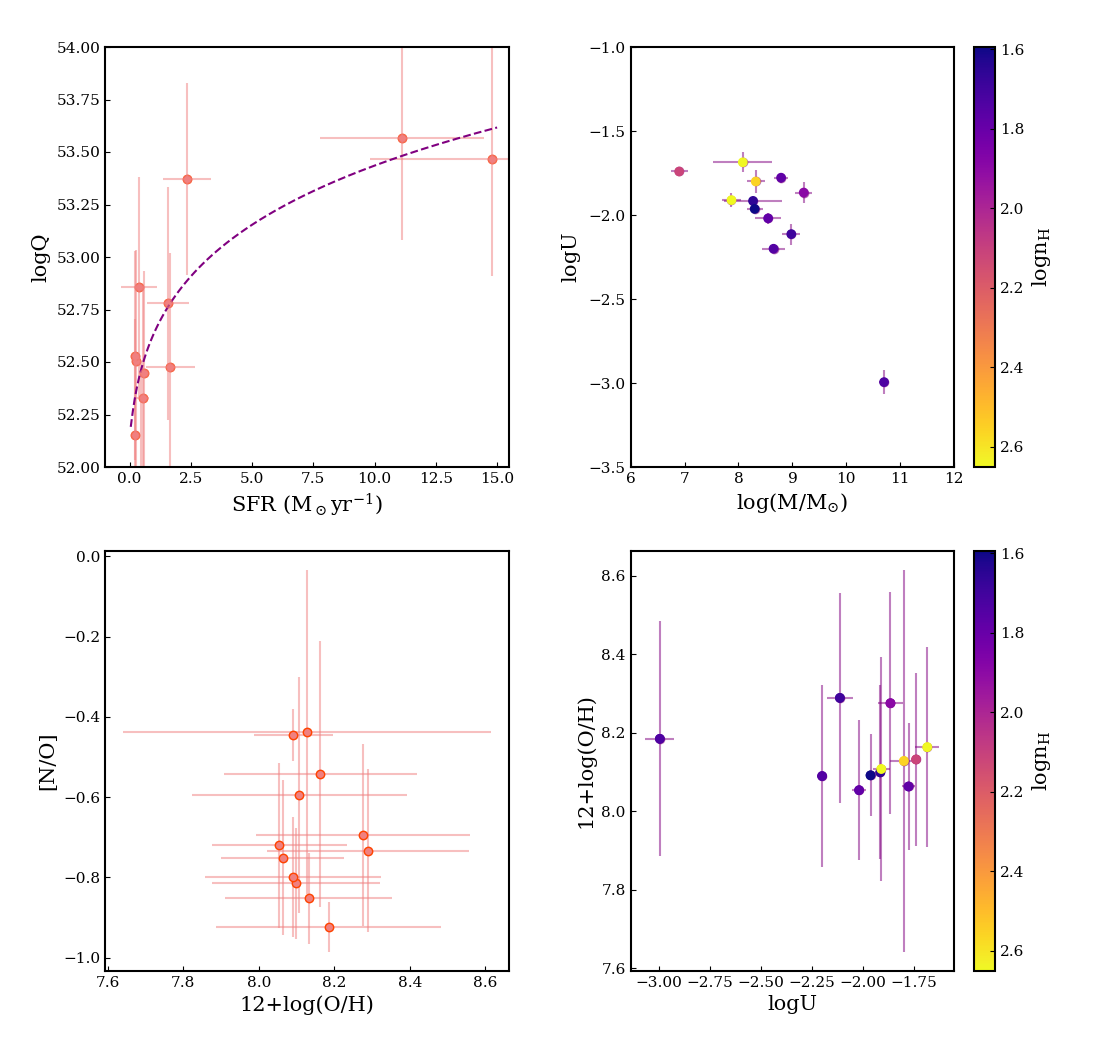
Our results show:
- The H-alpha sSFR and logQ, the rate of ionizing photons available per second, follow a trend. This finding is significant as it indicates that Cue is successful in producing physical values.
- We also find that logU, mass, and lognH exhibit an inverse correlation. This finding demonstrates that Cue outputs are self-consistent for these galaxies
- The [N/O] to [O/H] values are expected for young hosts of supernovae. However, we find metallicity and logU seemingly have no correlation, which is surprising for highly star-forming regions. This may be a step towards identifying potentially unique environments in SLSN-1 hosts.
Overall, we find that using Cue provides a promising method of characterizing SLSN host galaxies. However, both a larger sample of hosts and control group are necessary moving forward. Read more on my project here!
Stellar Continuum Modeling Accounting for Nonuniform Dust
Accounting for the effects of nonuniform dust when calculating galaxy properties is a difficult. As a result, astronomers assume uniform dust screens in attenuation calculations. This project presents a possible method of accounting for nonuniform dust screens using FiCUS, a stellar continuum fitting model developed by Alberto Saldana-Lopez. View my poster for this project here!.
Contact
Email: adtran2847@utexas.edu
ORCID ID: 0009-0009-6868-4457